 EZ Shadow
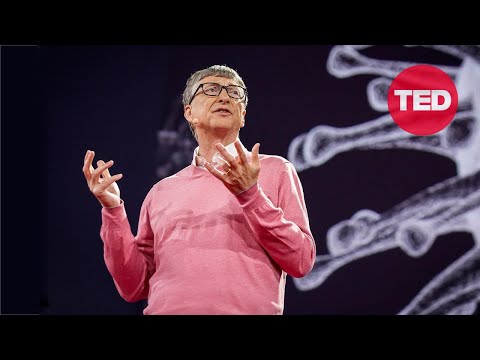
The next outbreak? We’re not ready | Bill Gates | TED
IntermediateAmerican accentTED talk9 min
Shadow this video one sentence at a time: listen, say it back, and get a score for every word.
Hard words
The longest, least common words in this video. Say them slowly before you start.
- epidemiologists
- breakthroughs
- orchestrating
- bioterrorism
- preparedness
- dramatically
- catastrophe
- devastating
Transcript: 94 sentences
Tap a sentence to start the drill right there.
- 0:18 When I was a kid, the disaster we worried about most was a nuclear war.
- 0:24 That's why we had a barrel like this down in our basement, filled with cans of food and water.
- 0:30 When the nuclear attack came, we were supposed to go downstairs, hunker down, and eat out of that barrel.
- 0:38 Today the greatest risk of global catastrophe doesn't look like this.
- 0:44 Instead, it looks like this.
- 0:48 If anything kills over 10 million people in the next few decades, it's most likely to be a highly infectious virus rather than a war.
- 1:00 Not missiles, but microbes.
- 1:04 Now, part of the reason for this is that we've invested a huge amount in nuclear deterrents.
- 1:10 But we've actually invested very little in a system to stop an epidemic.
- 1:16 We're not ready for the next epidemic.
- 1:20 Let's look at Ebola.
- 1:22 I'm sure all of you read about it in the newspaper, lots of tough challenges.
- 1:27 I followed it carefully through the case analysis tools we use to track polio eradication.
- 1:36 And as you look at what went on, the problem wasn't that there was a system that didn't work well enough, the problem was that we didn't have a system at all.
- 1:47 In fact, there's some pretty obvious key missing pieces.
- 1:51 We didn't have a group of epidemiologists ready to go, who would have gone, seen what the disease was, seen how far it had spread.
- 2:00 The case reports came in on paper.
- 2:02 It was very delayed before they were put online and they were extremely inaccurate.
- 2:07 We didn't have a medical team ready to go.
- 2:10 We didn't have a way of preparing people.
- 2:12 Now, Médecins Sans Frontières did a great job orchestrating volunteers.
- 2:18 But even so, we were far slower than we should have been getting the thousands of workers into these countries.
- 2:24 And a large epidemic would require us to have hundreds of thousands of workers.
- 2:33 There was no one there to look at treatment approaches.
- 2:37 No one to look at the diagnostics.
- 2:39 No one to figure out what tools should be used.
- 2:42 As an example, we could have taken the blood of survivors, processed it, and put that plasma back in people to protect them.
- 2:51 But that was never tried.
- 2:54 So there was a lot that was missing.
- 2:56 And these things are really a global failure.
- 3:00 The WHO is funded to monitor epidemics, but not to do these things I talked about.
- 3:07 Now, in the movies it's quite different.
- 3:10 There's a group of handsome epidemiologists ready to go, they move in, they save the day, but that's just pure Hollywood.
- 3:22 The failure to prepare could allow the next epidemic to be dramatically more devastating than Ebola
- 3:31 Let's look at the progression of Ebola over this year.
- 3:36 About 10,000 people died, and nearly all were in the three West African countries.
- 3:44 There's three reasons why it didn't spread more.
- 3:46 The first is that there was a lot of heroic work by the health workers.
- 3:51 They found the people and they prevented more infections.
- 3:54 The second is the nature of the virus.
- 3:57 Ebola does not spread through the air.
- 4:00 And by the time you're contagious, most people are so sick that they're bedridden.
- 4:06 Third, it didn't get into many urban areas.
- 4:10 And that was just luck.
- 4:12 If it had gotten into a lot more urban areas, the case numbers would have been much larger.
- 4:18 So next time, we might not be so lucky.
- 4:21 You can have a virus where people feel well enough while they're infectious that they get on a plane or they go to a market.
- 4:30 The source of the virus could be a natural epidemic like Ebola, or it could be bioterrorism.
- 4:35 So there are things that would literally make things a thousand times worse.
- 4:39 In fact, let's look at a model of a virus spread through the air, like the Spanish Flu back in 1918.
- 4:50 So here's what would happen: It would spread throughout the world very, very quickly.
- 4:56 And you can see over 30 million people died from that epidemic.
- 5:01 So this is a serious problem.
- 5:02 We should be concerned.
- 5:04 But in fact, we can build a really good response system.
- 5:09 We have the benefits of all the science and technology that we talk about here.
- 5:14 We've got cell phones to get information from the public and get information out to them.
- 5:18 We have satellite maps where we can see where people are and where they're moving.
- 5:22 We have advances in biology that should dramatically change the turnaround time to look at a pathogen and be able to make drugs and vaccines that fit for that pathogen.
- 5:33 So we can have tools, but those tools need to be put into an overall global health system.
- 5:40 And we need preparedness.
- 5:42 The best lessons, I think, on how to get prepared are again, what we do for war.
- 5:47 For soldiers, we have full-time, waiting to go.
- 5:51 We have reserves that can scale us up to large numbers.
- 5:54 NATO has a mobile unit that can deploy very rapidly.
- 5:58 NATO does a lot of war games to check, are people well trained?
- 6:01 Do they understand about fuel and logistics and the same radio frequencies?
- 6:06 So they are absolutely ready to go.
- 6:09 So those are the kinds of things we need to deal with an epidemic.
- 6:13 What are the key pieces?
- 6:15 First, we need strong health systems in poor countries.
- 6:21 That's where mothers can give birth safely, kids can get all their vaccines.
- 6:25 But, also where we'll see the outbreak very early on.
- 6:30 We need a medical reserve corps: lots of people who've got the training and background who are ready to go, with the expertise.
- 6:38 And then we need to pair those medical people with the military.
- 6:42 taking advantage of the military's ability to move fast, do logistics and secure areas.
- 6:48 We need to do simulations, germ games, not war games, so that we see where the holes are.
- 6:56 The last time a germ game was done in the United States was back in 2001, and it didn't go so well.
- 7:02 So far the score is germs: 1, people: 0.
- 7:07 Finally, we need lots of advanced R&D in areas of vaccines and diagnostics.
- 7:14 There are some big breakthroughs, like the Adeno-associated virus, that could work very, very quickly.
- 7:21 Now I don't have an exact budget for what this would cost, but I'm quite sure it's very modest compared to the potential harm.
- 7:29 The World Bank estimates that if we have a worldwide flu epidemic, global wealth will go down by over three trillion dollars
- 7:37 and we'd have millions and millions of deaths.
- 7:41 These investments offer significant benefits beyond just being ready for the epidemic.
- 7:47 The primary healthcare, the R&D, those things would reduce global health equity and make the world more just as well as more safe.
- 7:56 So I think this should absolutely be a priority.
- 8:00 There's no need to panic.
- 8:01 We don't have to hoard cans of spaghetti or go down into the basement.
- 8:05 But we need to get going, because time is not on our side.
- 8:09 In fact, if there's one positive thing that can come out of the Ebola epidemic,
- 8:16 it's that it can serve as an early warning, a wake-up call, to get ready.
- 8:21 If we start now, we can be ready for the next epidemic.
- 8:27 Thank you.
More Intermediate videos
 How to gain control of your free time | Laura Vanderkam | TEDIntermediateAmerican accentTED talk12 min
 Emma Watson at the HeForShe Campaign 2014 - Official UN VideoIntermediateBritish accentSpeech13 min
 What is depression? - Helen M. FarrellIntermediateAmerican accentAnimated lesson4 min