 EZ Shadow
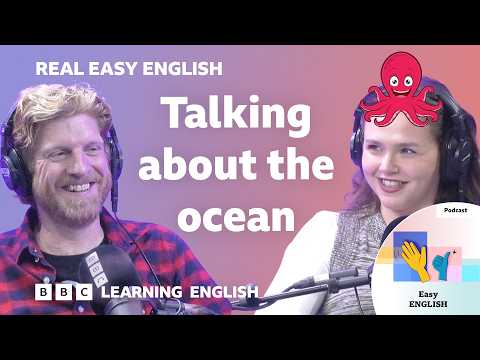
Octopuses or dolphins? Which is your favourite? | Improve your listening with Real Easy English
BeginnerBritish accentEasy English5 min
Shadow this video one sentence at a time: listen, say it back, and get a score for every word.
Hard words
The longest, least common words in this video. Say them slowly before you start.
- environmental
- conversation
- environment
- intelligent
- transcript
- vocabulary
- chemicals
- condition
Transcript: 80 sentences
Tap a sentence to start the drill right there.
- 0:00 Hi Becca.
- 0:01 How are you?
- 0:01 I'm well, thank you, Neil.
- 0:02 How are you?
- 0:03 I'm very well, thanks.
- 0:04 We're talking about oceans today, and I know you live near the sea.
- 0:10 Is that because you like oceans?
- 0:11 Yes, I do live near the seaside and I love oceans.
- 0:16 Well, we're going to be talking about the ocean in this episode, but people need to know that they can find a worksheet and a transcript
- 0:24 to help them understand everything on our website, at bbclearningenglish.com.
- 0:34 OK Becca.
- 0:35 So, why do you love the ocean?
- 0:38 Ooh, I love the ocean because it's very big and in there live lots of really cool sea creatures.
- 0:47 Yeah.
- 0:47 Have you got a favourite sea creature?
- 0:49 Difficult question for me to answer, Neil.
- 0:52 I love them all, but I really like octopuses.
- 0:56 Octopuses?
- 0:57 Why do you like octopuses?
- 0:59 They're very intelligent, very smart creatures.
- 1:03 And I also really like the way that they move through the water.
- 1:06 They swim with their tentacles.
- 1:08 Tentacles?
- 1:09 That's the name for their legs.
- 1:11 Yes.
- 1:12 Yeah.
- 1:12 And they can use their tentacles to also pick things up, which I think is really cool.
- 1:17 There aren't many sea creatures that can do that.
- 1:20 Do you know what my favourite sea creature is, Becca?
- 1:23 I don't know, Neil.
- 1:24 What is it?
- 1:24 I really like dolphins.
- 1:26 And I like dolphins for the same reason that you like your octopuses - because they're very intelligent, they're very clever, and they're very beautiful, I think - very...
- 1:37 they're very pretty to look at.
- 1:39 I think they're much more beautiful than octopuses.
- 1:41 Ooh, hold on now, Neil.
- 1:43 I don't think I agree with you.
- 1:45 Well, it doesn't matter if you prefer octopuses or dolphins.
- 1:49 There's lots of amazing creatures living in the sea, but there is actually a danger with the oceans.
- 1:56 They're not really in a good condition.
- 1:59 No.
- 1:59 There are lots of threats to the oceans right now.
- 2:02 So, a threat is a danger, and one of those threats is pollution.
- 2:09 Yeah.
- 2:09 Plastic is a real problem, isn't it?
- 2:12 So, the material that lots of bottles are made from that isn't glass.
- 2:17 That plastic ends up in the ocean, and then it's really bad for the sea creatures.
- 2:23 It is, yeah.
- 2:24 I've seen lots of videos of sea creatures maybe getting stuck in plastic bottles, and it's really sad.
- 2:32 Pollution and single-use plastic are major, major threats to the ocean.
- 2:38 Yes, there are lots of threats to the ocean.
- 2:41 For example, the plastic pollution that you are talking about.
- 2:46 Also, the oceans are getting warmer and that's a real threat because it can cause all kinds of environmental problems.
- 2:55 You're right, Neil.
- 2:56 There are lots of threats to the oceans.
- 2:58 Do you do anything to protect the oceans?
- 3:02 Well, I don't go near the ocean very often, so I don't do anything directly.
- 3:09 But I try not to use single-use plastic.
- 3:14 So, single-use plastic is plastic that you use just once and then you throw it away.
- 3:20 So, for example, single-use plastic straws for drinks - in the UK there are lots of places that don't use those anymore
- 3:30 and I think that's a good way to help protect the oceans.
- 3:39 OK.
- 3:40 Neil, let's recap some of the vocabulary that we used in this conversation.
- 3:44 We'll start with my favourite sea creature - that's an octopus.
- 3:48 So, 'octo-' means eight and octopuses have eight tentacles, and those are the arms of the octopus.
- 3:56 Or legs.
- 3:57 Or legs, yeah!
- 3:59 We also heard 'threat'.
- 4:01 Now, a threat is something that is a danger to something.
- 4:05 For example, the oceans getting warmer is a threat to the environment.
- 4:11 And another example of a threat that we mentioned was pollution.
- 4:16 And that is the things there that shouldn't be there.
- 4:19 They could be chemicals or rubbish, and pollution is very harmful to whatever lives in that environment.
- 4:27 Yes.
- 4:28 And a big problem - a big part of that pollution is single-use plastic.
- 4:34 'Single-use' means it's something that you use just once and then throw it away.
- 4:39 That's it for this episode of Real Easy English, but if you want to test yourself with a worksheet, you can find it on our website at bbclearningenglish.com.
- 4:48 And we'll be back next week with another episode of Real Easy English.
- 4:52 Bye for now.
- 4:53 Goodbye!
More Beginner videos
 Tips for feeling confident in job interviews | Improve your listening with Real Easy EnglishBeginnerBritish accentEasy English6 min
 What are your favourite famous sites? | Improve your listening with Real Easy EnglishBeginnerBritish accentEasy English7 min
 Films at home or at the cinema - which is better? | Improve your listening with Real Easy EnglishBeginnerBritish accentEasy English7 min