 EZ Shadow
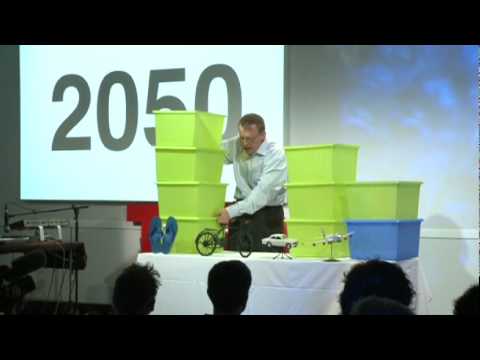
Hans Rosling: Global population growth, box by box
IntermediateSwedish English accentTED talk10 min
Shadow this video one sentence at a time: listen, say it back, and get a score for every word.
Hard words
The longest, least common words in this video. Say them slowly before you start.
- linguistically
- industrialized
- organizations
- analytically
- economically
- destination
- possibilist
- projections
Transcript: 107 sentences
Tap a sentence to start the drill right there.
- 0:16 I still remember the day in school when our teacher told us that the world population had become three billion people, and that was in 1960.
- 0:29 I'm going to talk now about how world population has changed from that year and into the future, but I will not use digital technology, as I've done during my first five TEDTalks.
- 0:41 Instead, I have progressed, and I am, today, launching a brand new analog teaching technology that I picked up from IKEA: this box.
- 0:53 This box contains one billion people.
- 0:55 And our teacher told us that the industrialized world, 1960, had one billion people.
- 1:02 In the developing world, she said, they had two billion people.
- 1:06 And they lived away then.
- 1:08 There was a big gap between the one billion in the industrialized world and the two billion in the developing world.
- 1:15 In the industrialized world, people were healthy, educated, rich, and they had small families.
- 1:23 And their aspiration was to buy a car.
- 1:27 And in 1960, all Swedes were saving to try to buy a Volvo like this.
- 1:33 This was the economic level at which Sweden was.
- 1:36 But in contrast to this, in the developing world, far away, the aspiration of the average family there was to have food for the day.
- 1:46 They were saving to be able to buy a pair of shoes.
- 1:51 There was an enormous gap in the world when I grew up.
- 1:55 And this gap between the West and the rest has created a mindset of the world, which we still use linguistically when we talk about "the West" and "the Developing World."
- 2:07 But the world has changed, and it's overdue to upgrade that mindset and that taxonomy of the world, and to understand it.
- 2:15 And that's what I'm going to show you, because since 1960 what has happened in the world up to 2010 is that a staggering four billion people
- 2:27 have been added to the world population.
- 2:29 Just look how many.
- 2:31 The world population has doubled since I went to school.
- 2:37 And of course, there's been economic growth in the West.
- 2:40 A lot of companies have happened to grow the economy, so the Western population moved over to here.
- 2:46 And now their aspiration is not only to have a car.
- 2:49 Now they want to have a holiday on a very remote destination and they want to fly.
- 2:54 So this is where they are today.
- 2:56 And the most successful of the developing countries, they have moved on, you know, and they have become emerging economies, we call them.
- 3:04 They are now buying cars.
- 3:06 And what happened a month ago was that the Chinese company, Geely, they acquired the Volvo company, and then finally the Swedes understood that something big had happened in the world.
- 3:20 So there they are.
- 3:22 And the tragedy is that the two billion over here that is struggling for food and shoes, they are still almost as poor as they were 50 years ago.
- 3:32 The new thing is that we have the biggest pile of billions, the three billions here, which are also becoming emerging economies, because they are quite healthy, relatively well-educated,
- 3:43 and they already also have two to three children per woman, as those have.
- 3:48 And their aspiration now is, of course, to buy a bicycle, and then later on they would like to have a motorbike also.
- 3:56 But this is the world we have today, no longer any gap.
- 4:03 But the distance from the poorest here, the very poorest, to the very richest over here is wider than ever.
- 4:09 But there is a continuous world from walking, biking, driving, flying -- there are people on all levels, and most people tend to be somewhere in the middle.
- 4:21 This is the new world we have today in 2010.
- 4:26 And what will happen in the future?
- 4:30 Well, I'm going to project into 2050.
- 4:34 I was in Shanghai recently, and I listened to what's happening in China, and it's pretty sure that they will catch up, just as Japan did.
- 4:44 All the projections this one will grow with one to two or three percent.
- 4:48 grows with seven, eight percent, and then they will end up here.
- 4:51 They will start flying.
- 4:53 And these lower or middle income countries, the emerging income countries, they will also forge forwards economically.
- 5:01 And if, but only if, we invest in the right green technology -- so that we can avoid severe climate change, and energy can still be relatively cheap --
- 5:13 then they will move all the way up here.
- 5:16 And they will start to buy electric cars.
- 5:20 This is what we will find there.
- 5:23 So what about the poorest two billion?
- 5:25 What about the poorest two billion here?
- 5:28 Will they move on?
- 5:30 Well, here population comes in because there we already have two to three children per woman, family planning is widely used, and population growth is coming to an end.
- 5:39 Here , population is growing.
- 5:42 So these two billion will, in the next decades, increase to three billion, and they will thereafter increase to four billion.
- 5:51 There is nothing -- but a nuclear war of a kind we've never seen -- that can stop this from happening.
- 5:59 Because we already have this in process.
- 6:02 But if, and only if, get out of poverty, they get education, they get improved child survival, they can buy a bicycle and a cell phone and come here, then population growth
- 6:13 will stop in 2050.
- 6:16 We cannot have people on this level looking for food and shoes because then we get continued population growth.
- 6:23 And let me show you why by converting back to the old-time digital technology.
- 6:30 Here I have on the screen my country bubbles.
- 6:34 Every bubble is a country.
- 6:35 The size is population.
- 6:36 The colors show the continent.
- 6:38 The yellow on there is the Americas; dark blue is Africa; brown is Europe; green is the Middle East and this light blue is South Asia.
- 6:47 That's India and this is China.
- 6:49 Size is population.
- 6:49 Here I have children per woman: two children, four children, six children, eight children -- big families, small families.
- 6:57 The year is 1960.
- 6:59 And down here, child survival, the percentage of children surviving childhood up to starting school: 60 percent, 70 percent, 80 percent, 90, and almost 100 percent, as we have today
- 7:10 in the wealthiest and healthiest countries.
- 7:12 But look, this is the world my teacher talked about in 1960: one billion Western world here -- high child-survival, small families -- and all the rest,
- 7:23 the rainbow of developing countries, with very large families and poor child survival.
- 7:29 What has happened?
- 7:30 I start the world.
- 7:31 Here we go.
- 7:32 Can you see, as the years pass by, child survival is increasing?
- 7:35 They get soap, hygiene, education, vaccination, penicillin and then family planning.
- 7:41 Family size is decreasing.
- 7:42 they get up to 90-percent child survival, then families decrease, and most of the Arab countries in the Middle East is falling down there .
- 7:49 Look, Bangladesh catching up with India.
- 7:51 The whole emerging world joins the Western world with good child survival and small family size, but we still have the poorest billion.
- 8:02 Can you see the poorest billion, those boxes I had over here?
- 8:07 They are still up here.
- 8:09 And they still have a child survival of only 70 to 80 percent, meaning that if you have six children born, there will be at least four who survive to the next generation.
- 8:19 And the population will double in one generation.
- 8:22 So the only way of really getting world population to stop is to continue to improve child survival to 90 percent.
- 8:31 That's why investments by Gates Foundation, UNICEF and aid organizations, together with national government in the poorest countries, are so good; because they are actually helping us to reach
- 8:43 a sustainable population size of the world.
- 8:45 We can stop at nine billion if we do the right things.
- 8:48 Child survival is the new green.
- 8:51 It's only by child survival that we will stop population growth.
- 8:56 And will it happen?
- 8:58 Well, I'm not an optimist, neither am I a pessimist.
- 9:03 I'm a very serious "possibilist."
- 9:06 It's a new category where we take emotion apart, and we just work analytically with the world.
- 9:11 It can be done.
- 9:14 We can have a much more just world.
- 9:17 With green technology and with investments to alleviate poverty, and global governance, the world can become like this.
- 9:25 And look at the position of the old West.
- 9:28 Remember when this blue box was all alone, leading the world, living its own life.
- 9:34 This will not happen .
- 9:36 The role of the old West in the new world is to become the foundation of the modern world -- nothing more, nothing less.
- 9:45 But it's a very important role.
- 9:47 Do it well and get used to it.
- 9:49 Thank you very much.
More Intermediate videos
 Could vaccines cure cancer? 6 Minute EnglishIntermediateBritish accentPodcast6 min
 Is aircon the answer to a heating world? 6 Minute EnglishIntermediateBritish accentPodcast6 min
 What should you eat for a better night’s sleep? 6 Minute EnglishIntermediateBritish accentPodcast6 min