 EZ Shadow
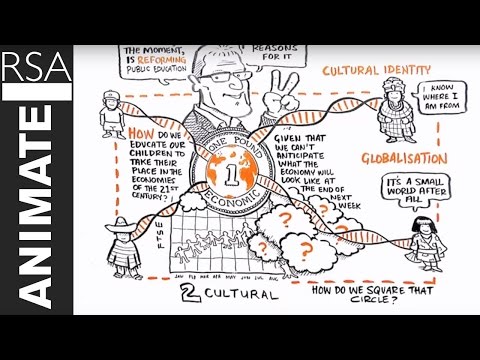
RSA ANIMATE: Changing Education Paradigms
AdvancedBritish accentAnimated talk12 min
Shadow this video one sentence at a time: listen, say it back, and get a score for every word.
Hard words
The longest, least common words in this video. Say them slowly before you start.
- standardization
- anesthetizing
- circumstances
- demonstrating
- globalization
- industrialism
- prescriptions
- psychologists
Transcript: 158 sentences
Tap a sentence to start the drill right there.
- 0:15 every country on earth at the moment is reforming public education there are two
- 0:20 reasons for it the first of them is economic people are
- 0:23 trying to work out how do we
- 0:26 educate our children to take their place in the economies of the 21st century how
- 0:30 do we do that given that we can't anticipate what the economy will look like at the end of
- 0:35 next week as the recent turmoil is demonstrating
- 0:40 how do we do that the second though is cultural every
- 0:44 country on earth on earth is trying to figure out how do we
- 0:48 educate our children so they have a sense of cultural identity and so that we can pass on the cultural genes of our
- 0:53 communities while being part of the process of globalization how do you square that
- 0:58 circle the problem is they're trying to meet
- 1:02 the future by doing what they did in the past and on the way they're alienating
- 1:07 millions of kids who don't see any purpose in going to school when we went to school
- 1:12 we were kept there with a story which is if you worked hard and did well and got
- 1:16 a college degree you would have a job our kids don't believe that and they're
- 1:20 right not to by the way you're better having a degree than not but it's not a
- 1:24 guarantee anymore and particularly not if the route to it marginalizes most of
- 1:29 things that you think are important about yourself some people say we have to raise standards if this is a breakthrough
- 1:34 you know like really yes we should
- 1:38 why would you lower them you know i mean i haven't come across an argument that
- 1:42 persuades me of lowering them but raising them of course we should raise them
- 1:46 the problem is that the current system of education was designed
- 1:51 and conceived and structured for a different age
- 1:56 it was conceived in the intellectual culture of the
- 2:00 enlightenment and in the economic circumstances of the
- 2:04 industrial revolution before the middle of the 19th century there were no systems of public
- 2:09 education not really i mean you could get educated
- 2:12 by jesuits you know if you had the money
- 2:14 but public education paid for from taxation compulsory to everybody and
- 2:19 three at the point of delivery that was a revolutionary idea
- 2:22 and many people objected to it they said it's not possible
- 2:27 for many street kids working-class children to benefit from public education they're incapable of learning
- 2:32 to read and write and why we're spending time on this so there's also built into it a whole
- 2:36 series of um assumptions about social structure
- 2:40 and capacity it was driven by an economic imperative of the time but
- 2:44 running right through it
- 2:46 um was an intellectual model of the mind which was essentially
- 2:51 the enlightenment view of intelligence that real intelligence consists in this capacity for a certain type of deductive
- 2:56 reasoning and the knowledge of the classics originally what we come to think of as academic
- 3:01 ability and this is deep in the gene pool of
- 3:05 public education at the really two types of people academic and non-academic
- 3:09 smart people and non-smart people and the consequence of that is that many
- 3:13 brilliant people think they're not because they've been judged against this
- 3:17 particular view of the mind so we have twin pillars economic and
- 3:22 intellectual and my view is
- 3:25 that this model has caused chaos in many people's lives it's been great for some
- 3:31 there have been people who benefited wonderfully from it but most people have not
- 3:36 instead they suffer this this is the modern epidemic and it's as
- 3:40 misplaced and it's as fictitious
- 3:43 this is the plague of adhd
- 3:47 now this is a map of the instance of
- 3:49 adhd in america or prescriptions for adhd
- 3:54 don't mistake me i don't mean to say there is no such thing
- 3:58 as attention deficit disorder i'm not qualified to say if there is such a
- 4:02 thing i know that a great majority of psychologists and children pediatrician
- 4:05 think there is such a thing
- 4:07 but it's still a matter of debate
- 4:11 what i do know for a fact is it's not an epidemic
- 4:15 these kids are being medicated
- 4:18 as routinely as we had our tonsils taken
- 4:20 out and on the same whimsical basis and for the same reason medical
- 4:25 fashion our children are living in the most
- 4:29 intensely stimulating period in the
- 4:31 history of the earth
- 4:34 they're being besieged with information and caused their attention from every
- 4:38 platform computers from iphones from advertising holdings
- 4:43 from hundreds of television channels and we're penalizing them now for
- 4:46 getting distracted
- 4:49 from what you know boring stuff
- 4:52 at school for the most part it seems to me not a coincidence totally
- 4:56 that the incidence of adhd has risen in parallel with the growth of standardized testing
- 5:01 now these kids are being given ritalin and adderall and all manner of things
- 5:05 often quite dangerous drugs to get them focused and calm them down
- 5:10 but according to this attention deficit order increases as you travel east
- 5:14 across the country people start losing interest in oklahoma
- 5:25 they can hardly think straight in arkansas and by the time they get to washington
- 5:29 they've lost it completely and there are separate reasons for that i believe
- 5:36 it's a fictitious epidemic if you think of it the arts
- 5:41 and i don't say this exclusively the arts i think it's also true of science
- 5:44 and of maths but let me i say about the art particularly because they are the
- 5:48 victims of this mentality currently particularly
- 5:52 the arts especially address the idea of aesthetic
- 5:58 experience an aesthetic experience is one in which your senses are operating at their peak
- 6:03 when you're present in the current moment when you're resonating with the
- 6:07 excitement of this thing that you're
- 6:09 experiencing when you are fully alive
- 6:12 an anesthetic is when you shut your senses off
- 6:16 and deaden yourself to what's happening and a lot of these drugs are that
- 6:22 we're getting our children through education by anesthetizing them and i think we should be doing the exact
- 6:27 opposite we shouldn't be putting them asleep we should be waking them up to
- 6:30 what they have inside of themselves but the model we have is this it's i
- 6:34 believe we have a system of education
- 6:36 that is modeled on
- 6:39 the interests of industrialism and in the image of it
- 6:43 i'll give you a couple of examples uh schools are still pretty much organized
- 6:47 on factory lines ringing bells separate facilities
- 6:51 specialized into separate subjects
- 6:54 we still educate children by batches you know we put them through the system
- 6:58 by age group why do we do that you know why is there this assumption
- 7:03 that the most important thing kids have in common is how old they are you know it's like the most important
- 7:09 thing about them is their date of manufacture what do you mean well i know kids who are much better
- 7:13 than other kids at the same age in different disciplines you know or at different times of the day
- 7:18 or better in smaller groups than in large groups or sometimes they want to be on their own if you're interested in the model of
- 7:23 learning you don't start from this production line mentality these are it's essentially about conformity and
- 7:28 increasingly it's about that as you look at the growth of standardized testing and standardized curricula
- 7:33 and it's about standardization i believe we've got to go in the exact opposite direction that's what i mean
- 7:38 about changing the paradigm there was a great study done recently of
- 7:42 divergent thinking published a couple of years ago
- 7:46 divergent thinking isn't the same thing as creativity
- 7:49 i define creativity as the the process
- 7:51 of having original ideas that have value
- 7:54 divergent thinking isn't a synonym but it's a
- 7:59 an essential capacity for creativity it's the ability to see lots of possible
- 8:04 answers to a question lots of possible ways of
- 8:07 interpreting a question uh to think what edward de boehner would probably
- 8:11 call laterally to think not just in linear or
- 8:15 convergent ways to see multiple answers not one
- 8:19 so i mean the test for this i mean one kind of cod example would be people might be asked to say
- 8:24 how many uses can you think of for a paper clip
- 8:28 all those routine questions most people might come with 10 or 15. people are good at this might come up
- 8:33 with 200 and they do that by saying well could the paper clip be 200 foot tall and be
- 8:38 made out of foam rubber you know like does it have to be a paper clip as we know it jim you know
- 8:42 um now they tested this and they gave them to 1500 people in a book called
- 8:47 breakpoint and beyond and on the protocol of the test if you
- 8:50 scored above a certain level you'd be considered to be a genius at divergent thinking
- 8:56 okay so my question to you is what percentage
- 9:00 of the people tested of the 1500
- 9:03 scored at genius level for divergent thinking now you need to know one more
- 9:07 thing about them these were kindergarten children
- 9:11 so what do you think what percentage at genius level eight eighteen
- 9:16 eighty okay 98 now the thing about this was it was a
- 9:19 longitudinal study so they retested the same children
- 9:24 five years later age of eight to ten what do you think
- 9:28 15. they retested this them again five years later ages
- 9:34 13-15 you can see a trend here can't you
- 9:39 now this tells an interesting story
- 9:43 because you could have imagined it going the other way couldn't you you start off not being very good but
- 9:48 you get better as you get older but this shows two things one is we all have this
- 9:52 capacity and two it mostly deteriorates
- 9:57 now a lot of things have happened to these kids as they've grown up a lot
- 10:01 but one of the most important things that i'm convinced is that by now they've become educated
- 10:06 they know they're spent ten years at school being told there's one answer it's at the back
- 10:11 and don't look and don't copy because that's cheating
- 10:16 i mean outside schools that's called collaboration you know but inside schools
- 10:21 now this isn't because teachers want it this way it's just because it happens
- 10:24 that way um it's because it's in the gene pool of
- 10:29 education we have to think differently about human
- 10:31 capacity we have to get over this old
- 10:34 conception of academic non-academic
- 10:37 abstract theoretical vocational
- 10:40 and see it for what it is a myth
- 10:44 secondly we have to recognize that most great learning happens in groups the
- 10:48 collaboration is the stuff of growth if we atomize people and separate them
- 10:52 and judge them separately we
- 10:56 form a kind of disjunction between them and their natural learning environment
- 11:00 and thirdly it's crucially about the culture of our institutions the habits
- 11:04 of the institution and the habitats that they occupy
- 11:40 you
More Advanced videos
 The Immune System Explained I - Bacteria InfectionAdvancedAmerican accentAnimated essay6 min
 What Is Life? Is Death Real?AdvancedAmerican accentAnimated essay6 min
 Why Meat is the Best Worst Thing in the World | KurzgesagtAdvancedAmerican accentAnimated essay8 min