 EZ Shadow
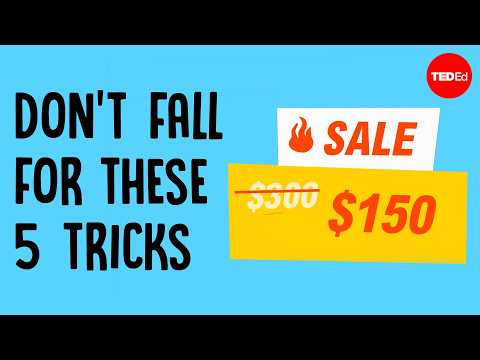
5 sneaky ways stores get you to spend more
IntermediateAmerican accentAnimated lesson6 min
Shadow this video one sentence at a time: listen, say it back, and get a score for every word.
Hard words
The longest, least common words in this video. Say them slowly before you start.
- investigating
- psychologists
- psychological
- increasingly
- intersection
- advertisers
- constraints
- emphasizing
Transcript: 46 sentences
Tap a sentence to start the drill right there.
- 0:07 You're about to buy some bargain bin headphones when you spot a real bargain.
- 0:12 This pair is more expensive, but it's selling for half its usual price.
- 0:18 Surely this is the better buy, right?
- 0:21 It’s possible!
- 0:23 However, it’s also possible you’re falling for a psychological trick retailers use to influence what you buy and what you’re willing to pay.
- 0:34 From the late 1800s, economic theory often assumed that consumers were rational actors who pursued the optimal financial choice.
- 0:45 But while consumers are reasonably rational on average, they’re also vulnerable to impulse purchases, savvy salespeople,
- 0:54 and other external factors that make them, well, irrational.
- 0:59 20th century psychologists investigating these factors learned that human decision making is rarely perfectly logical.
- 1:09 And by the 1970s, this research informed the birth of behavioral economics,
- 1:15 a new field exploring the intersection of economics and psychology.
- 1:22 Behavioral economics operated off a new assumption, introduced by economic sciences laureate Herbert Simon.
- 1:31 His model, called “bounded rationality,” argued that consumers have limited information, limited time, and various psychological constraints
- 1:41 that lead them not to the optimal financial choice, but simply one they feel good about.
- 1:48 So how do we decide what's good enough?
- 1:51 Rather than using logic, behavioral economists say we fall back on heuristics - mental shortcuts for making decisions easier and faster.
- 2:02 For example, the anchoring heuristic suggests that the first piece of information you get becomes your baseline for future decision making.
- 2:12 So if a menu's first item costs $50, you'll compare other prices against that reference point.
- 2:20 Psychologists like Daniel Kahneman thought heuristics predict many consumer choices - which means they can be manipulated to control them.
- 2:30 Case in point, while those discounted headphones might be 50% off, it’s also possible the original price was inflated to begin with.
- 2:41 Anchoring is just one of many heuristics retailers exploit.
- 2:46 Consider this: which of these cleaning products would you buy?
- 2:50 How about now?
- 2:52 Both are equally effective and basically cost the same, but careful language and pricing makes one more appealing.
- 3:01 This is the framing effect, and it’s one of several psychological phenomena that short circuit our ability to assign value.
- 3:11 Here’s an example of another: some American grocery stores tried encouraging customers to bring reusable shopping bags by offering a 5 cent credit.
- 3:22 But this proved less effective than charging a 5 cent fee for using disposable bags.
- 3:28 In other words, the desire to avoid losing 5 cents was more motivating than gaining 5 cents.
- 3:36 This is called loss aversion, and retailers trigger this fear of losing value by emphasizing a sale’s scarcity or looming deadline.
- 3:47 All these tactics suggest our perception of value is more important than what something is actually worth.
- 3:56 And that effect goes deeper than you might think.
- 4:00 In a 2008 study, subjects were put into MRI machines and treated to samples from five bottles of increasingly expensive wine.
- 4:11 Participants reported preferring the expensive samples, and MRI images confirmed this claim.
- 4:18 But in reality they only tasted three bottles, with the two cheapest pulling double duty as the two priciest.
- 4:28 Of course, retailers don’t just manipulate your perception, they control the spaces you shop.
- 4:36 Supermarkets often place high-margin items at eye level and design stores to guide you past them.
- 4:44 Behavioral economist Richard Thaler and legal scholar Cass Sunstein call this subtle product placement “nudge theory,” and it works online as well.
- 4:56 Sites might nudge you by suggesting related items to purchase or by pre-selecting add-ons.
- 5:03 So if retailers are boxing you in, what can you do about it?
- 5:08 First, shop slower.
- 5:10 Heuristic-based decision making is quick and instinctive, so slowing down to run the numbers can pull back the curtain on a flashy deal.
- 5:22 Deciding what a product is worth to you before shopping can help set your own anchors.
- 5:29 And always ask yourself why you want this deal.
- 5:32 Buying something just because it’s a bargain means you might not be in control of your choice.
- 5:40 Above all, remember that retailers and advertisers aren’t just selling products - they’re designing your choices.
- 5:48 And once you understand the psychology behind their designs, you might gain something even more valuable than a discount: the ability to choose on your own terms.
More Intermediate videos
 3 things to never do with a credit cardIntermediateAmerican accentAnimated lesson6 min
 4 ways to fix your attention span - Shannon OdellIntermediateAmerican accentAnimated lesson5 min
 Ever walk into a room and forget what you were doing? - Gabriel RadvanskyIntermediateAmerican accentAnimated lesson5 min